
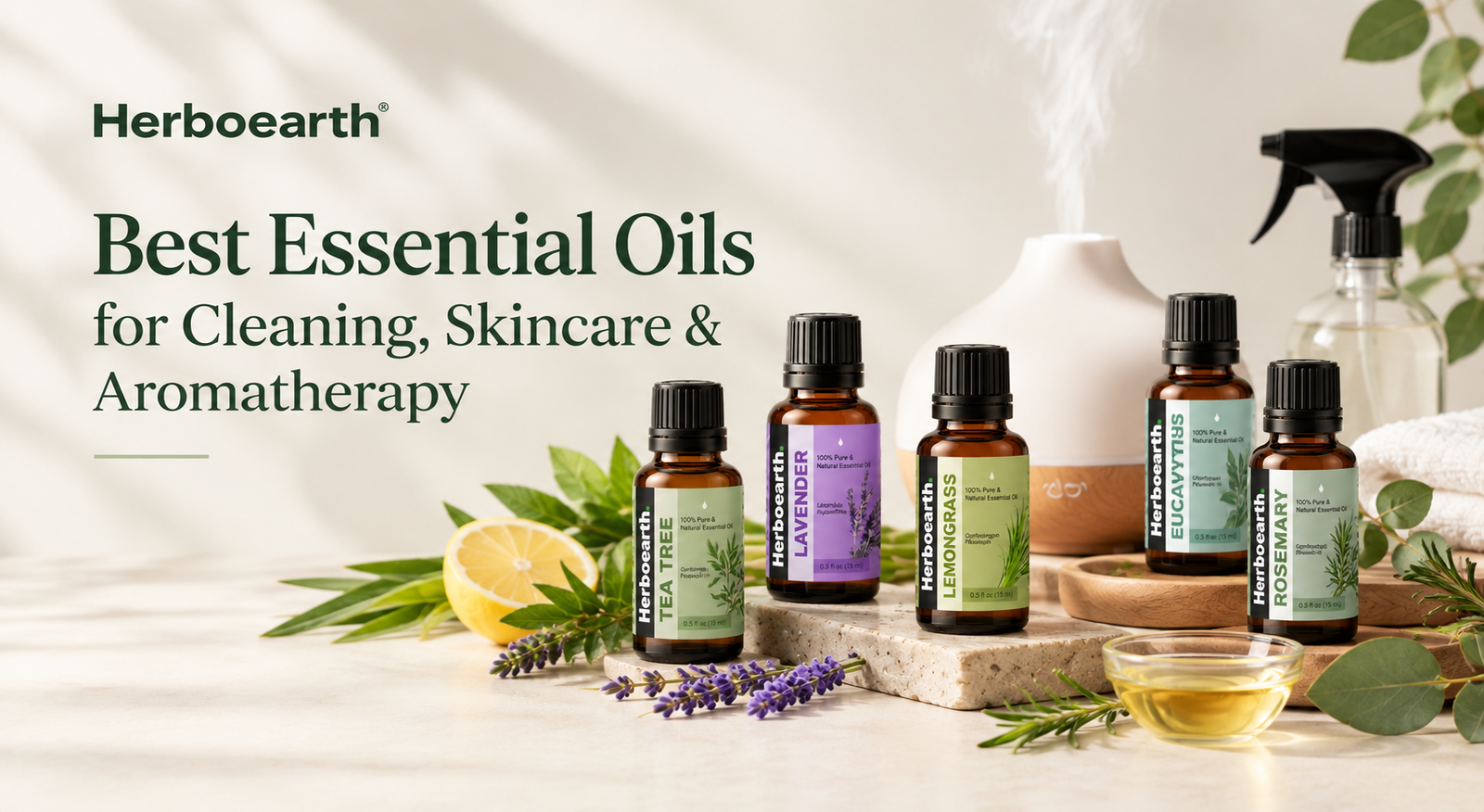
Best Essential Oils for Cleaning, Skincare & Aromatherapy
Quick Answer: What Is the Best Essential Oil? There is no single “best” essential oil — the right one depends on what you’re using it for. Lavender is the most
Free Delivery in USA and Nepal on orders over $50
Quick Answer: What Is the Best Essential Oil?
There is no single “best” essential oil — the right one depends on what you’re using it for. Lavender is the most versatile all-rounder for sleep, skin, and everyday calm. Tea tree is the top pick for cleaning and blemish-prone skin. Peppermint and eucalyptus lead for congestion and an energy lift. Rosemary is the oil most people reach for to support hair growth and thickness. Across every category, the oils worth buying share three traits: 100% pure with no synthetic fillers, consistent from batch to batch, and sold by a brand that’s upfront about where the plant was grown and how the oil was extracted.
Most people buy their first essential oil for one reason and end up using it for three. A bottle of tea tree bought to spot-treat a breakout ends up in the laundry room, the diffuser, and the gym bag within a month. That’s the real appeal of essential oils in American households today: a single, concentrated plant extract that can freshen a kitchen counter, calm a bedtime routine, and replace a few synthetic air fresheners and cleaning sprays at the same time.
This guide breaks down the best essential oils for three specific jobs — natural cleaning, skincare, and aromatherapy — along with the best carrier oils to pair them with, how to pick an essential oil diffuser (including options for large spaces), and how the major U.S. essential oil brands actually compare. Every recommendation below is built around oils that are easy to find and affordable to use consistently, not rare, expensive specialty oils you’ll only use once.
Established U.S. essential oil brands — Plant Therapy, Edens Garden, Rocky Mountain Oils, Mountain Rose Herbs, and MLM names like Young Living — have trained American shoppers to expect a few baseline standards before they’ll call an oil “the best essential oil” in a category:
HerboEarth’s 15ml line (Lavender, Tea Tree, Peppermint, Eucalyptus, Rosemary, Lemongrass, Citronella, and Wintergreen) is built on the same checklist: single-origin, 100% pure oils inspired by Himalayan botanical sourcing, bottled for the U.S. market, and sold direct so wholesale and retail customers pay for the oil, not a multi-level marketing structure.
Several essential oils are naturally antibacterial and antifungal, which is why they show up so often in DIY cleaning blogs and natural-living kitchens across the U.S.
| Oil | Best for | Why it works |
|---|---|---|
| Tea Tree | Bathrooms, mold-prone spots | Strong antibacterial and antifungal reputation; cuts through soap scum and musty smells |
| Lemongrass | Kitchen counters, cutting boards | Bright, citrus-forward scent; commonly used in natural all-purpose sprays |
| Citronella | Patios, outdoor spaces, trash areas | Doubles as a natural insect deterrent while it freshens the air |
| Eucalyptus | Floors, laundry, gym bags | Crisp, medicinal scent that cuts through staleness and sweat odor |
Skip this blend on natural stone (marble, granite) since vinegar can etch the surface over time, and always spot-test a new blend on a small, hidden area first.
Essential oils are never applied straight to skin — they’re always blended into a carrier oil first. Here are the three most popular for skincare and what each is known for:
The “best” carrier oil depends on your skin type, but three come up again and again in skincare blends:
| Carrier oil | Good for | Notes |
|---|---|---|
| Jojoba oil | Most skin types, including oily/acne-prone | Closely mimics skin’s natural sebum; rarely clogs pores |
| Sweet almond oil | Normal to dry skin | Light, fast-absorbing, mild scent |
| Fractionated coconut oil | Body oils, massage blends | Stays liquid at room temperature, very affordable |
A standard skincare dilution is 1% to 2%: roughly 3–6 drops of essential oil per ounce (30ml) of carrier oil. Always patch-test a new blend on your inner forearm and wait 24 hours before applying it to your face.
Aromatherapy is simply inhaling essential oils — through a diffuser, a steam bowl, or a personal inhaler — to shift the mood or feel of a room. The most reached-for oils for this are:
Most home diffusers fall into two categories:
| Diffuser type | Best for | Notes |
|---|---|---|
| Ultrasonic | Bedrooms, offices, rooms under ~300 sq ft | Uses water + oil; also adds light humidity; quiet operation |
| Nebulizing | Large or open-concept rooms, 400+ sq ft | No water needed, disperses pure oil as a fine mist; stronger scent throw, uses oil faster |
For the best essential oil diffuser for a large space — an open living room, a studio, or a yoga/wellness space — a nebulizing diffuser or a higher-output ultrasonic model rated for 500+ sq ft will cover the room far better than a small bedroom unit. Whichever type you choose, 3–5 drops is enough per diffuser cycle; more oil doesn’t mean more scent, it just empties the bottle faster.
When it comes to stuffy noses and seasonal congestion, three oils consistently come up as the most reached-for:
Two ways to use them safely:
Never apply undiluted essential oil directly under the nose or inside the nostrils, and keep diffusers with eucalyptus or peppermint out of rooms with infants or very young children, since both oils are generally considered unsuitable for that age group. This information is for general wellness use and isn’t a substitute for advice from a doctor, especially for ongoing or severe congestion.
Rosemary essential oil is the one most consistently recommended for hair growth and thickness, and it’s the most searched “hair oil” essential oil in the U.S. right now. It’s commonly used in scalp massage oils and has been the subject of small clinical comparisons against standard scalp treatments, with researchers reporting comparable improvements in hair fullness over several months of consistent use.
How to use it:
Rosemary oil is a stimulant, so it isn’t recommended for anyone with high blood pressure, epilepsy, or who is pregnant, without first checking with a doctor. It’s a wellness habit, not a treatment, and results vary from person to person.
There’s no single winner — the best essential oil brands in the U.S. split by price, sourcing style, and whether they sell direct or through a multi-level marketing model. Here’s how the most-searched names compare:
| Brand | Price point | Sales model | Known for |
|---|---|---|---|
| Plant Therapy | Budget to mid-range | Direct to consumer | Large catalog, widely available, popular with beginners |
| Edens Garden | Budget to mid-range | Direct to consumer | Wide range of pre-made blends, affordable single oils |
| Rocky Mountain Oils | Mid-range | Direct to consumer | Non-MLM, quality-focused, loyalty rewards program |
| Mountain Rose Herbs | Mid to premium | Direct to consumer | Long-standing herb company, organic and fair-trade focus |
| Young Living | Premium | Multi-level marketing (MLM) | Brand recognition; oils sold through independent distributors |
| HerboEarth | Budget to mid-range | Direct to consumer, wholesale available | Himalaya-inspired sourcing, single-origin 15ml bottles, U.S.-based, no MLM markup |
If you’re comparing brands for the first time, the simplest filter is this: skip anything that won’t tell you where the plant was grown or how the oil was tested, and be cautious of MLM pricing, since a large share of the sticker price there goes to the distributor network rather than the oil itself.
Essential oils are highly concentrated plant extracts, so a little goes a long way. A few ground rules apply across every oil in this guide:
| Use case | Typical dilution | Drops per 1 oz (30ml) carrier oil |
|---|---|---|
| Face/sensitive skin | 1% | 5–6 drops |
| Body oils, scalp massage | 2–3% | 10–18 drops |
| Diffuser (any room) | N/A | 3–5 drops per cycle |
These statements have not been evaluated by the Food and Drug Administration. HerboEarth’s essential oils are not intended to diagnose, treat, cure, or prevent any disease, and are sold for aromatic and cosmetic use only.
What is the best essential oil?
It depends on the job: Lavender for an all-around calming oil, Tea Tree for cleaning and skin, Peppermint or Eucalyptus for congestion and energy, and Rosemary for hair and scalp care.
What is the best carrier oil for essential oils?
Jojoba oil is the most versatile choice for most skin types, since it closely matches skin’s natural oils. Sweet almond oil suits drier skin, and fractionated coconut oil is a budget-friendly option for body and massage blends.
What is the best essential oil brand?
There’s no universal “best” — Plant Therapy and Edens Garden are known for affordable, wide catalogs; Rocky Mountain Oils and Mountain Rose Herbs lean mid-to-premium with a quality focus; and HerboEarth offers single-origin, 100% pure 15ml oils direct to U.S. customers, with wholesale pricing available.
Which essential oil is best for hair growth and thickness?
Rosemary essential oil is the most commonly used for this, diluted into a carrier oil and massaged into the scalp 2–3 times a week over several months.
What’s the best essential oil diffuser for a large space?
A nebulizing diffuser, or an ultrasonic diffuser rated for 500+ square feet, covers an open living room or studio far better than a small bedroom-sized unit.
The best essential oil isn’t the one with the biggest marketing budget — it’s the one that’s pure, correctly diluted, and matched to what you actually want it to do: a fresher kitchen, calmer skin, a better night’s sleep, or a room that finally smells the way you want it to. Start with one or two oils that cover the most ground — Lavender and Tea Tree are the easiest entry point — and build your collection from there.
HerboEarth’s 100% pure, Himalaya-inspired essential oils are sourced and bottled for U.S. households, with wholesale pricing available for retailers and spas. Shop the full collection or explore oils by what you need them for on the Shop by Concern page.
Quick Answer: What Is the Best Essential Oil? There is no single “best” essential oil — the right one depends on what you’re using it for. Lavender is the most
Maybe a friend gave you a bottle of lavender. Maybe you picked up a diffuser on sale and now it’s sitting on your counter. Either way, you’ve got essential oils
You bought a few bottles of essential oils, and now you’re staring at them wondering what to do next. Can you combine them? Do you need a carrier oil? How